Monday, 28 November 2011

Stop and take stock

'Ang on', 'Stop and take stock' We are bowling along with endless ideas but getting a bit bogged down. when making takes too long to do we loose our spontaneity, freshness, and fun.  We enjoyed up-cycling the clothes to sell on a market stall to fund our projects but it presented us with a nightmare of logistics to solve.  It seemed to be a distraction from what we really wanted to be doing.


Back to the museum.  We had an idea of transforming the trailer  from being a museum into different scenarios.  

  1. The Cart Tarts- watch out for us cycling around or even setting up for a tea break.  We will share a cuppa with ya and the chance to let off steam about some social issue that is burning.
  2. Making a gift- in a consumer world controlled by capitalism.We are giving you the chance to step outside of all of that and just MAKE something to GIVE to someone else without any expectations of any money in return.  Watch out for us on December 18th around the Peak District.
  3. Pen & Cil- the cleaning ladies go walkabout- collecting debris we find and transforming it into abstract landscapes.
But we still haven't completed the museum yet. More thoughts on the projects ongoing:
The Geocache is ready to go.
The static museums are under way- collecting artifacts and characters.
Talks- and we are ready to go and talk to anybody about the project.  If you are interested then you can contact us on: 
07974 785624
Almost forgot the e-card!


Friday, 18 November 2011

"Are we there yet?" " 'Ardly."

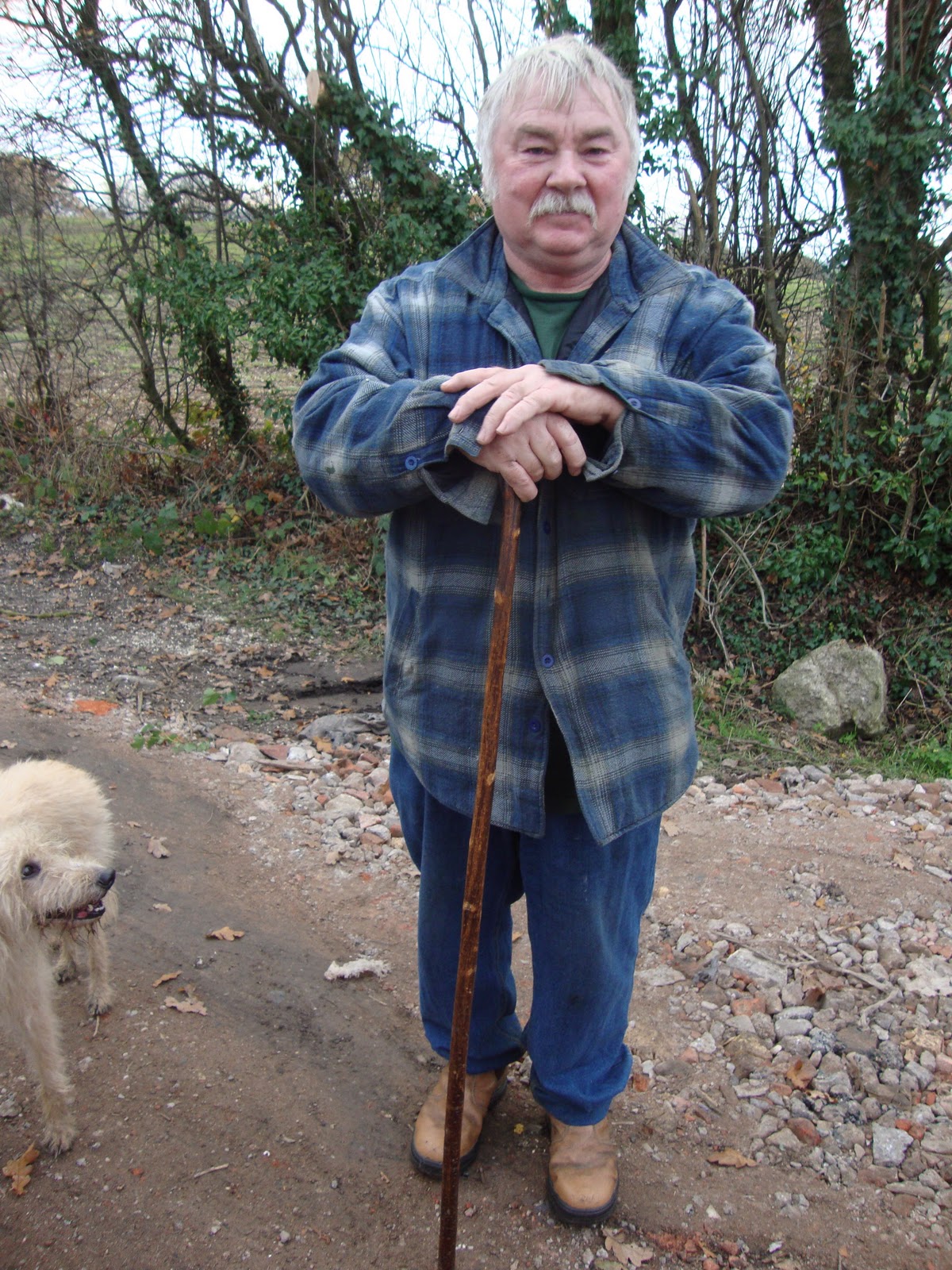
"Where have you been today?" he said. "Round about, up and down and through and through" we said, "Collecting men" we said. Well, photographs of local characters for the fantasy museum. We found Ibsley the dancer, Red Lynch Woodfalls the lumber jack, Elcot the twitcher, John Erith the smuggler and his acomplice who has yet to be named, and Ardley with his bag of freshly collected bluets. Next time we need to collect some women too. It felt like Mr Ben's changing room coming to life. They were all intrigued and we made them smile. What good sports. It dispelled Sally L's notion that everybody had been looking grumpy earlier. 

This is bringing fantasy back into the museum- our original concept. Funny how people like telling the truth in their stories. Some of those have already been in the local newspapers; we are scanning them all, ready for the Geocaching and The Book. There are many strands to this project, wish we could make it sustainable.


Oswald Ibsley - The Dancer whose family disowned him because he wouldn't stop dancing


Redlynch Woodfalls- The Lumberjack who forgot to shout 'Timber'


The Twitcher- Clench Warton Always at the first sighting of a bird. Had a second sense about being in the right place at the right time.


John Earith & associate- The Smugglers


Ardley- The Man whose reply to the question 'Are we at Bicester yet?' was 'Ardley'

Wednesday, 12 October 2011

In our neck of the woods

Indecisive beginnings led to a meander.  When you know a place well it seems like it won't be much of an adventure and which way to go is less intriguing.  So we headed to The Midland Railway Centre at Swanwick Junction to see what stories we could find. It was deserted; undeterred we passed the No Cycling sign and carried on In Search of...  We finally found three jolly chappies who were in search of their lost pile of sand. 45 minutes later we left them with a wealth of stories and in return we put a smile back on their faces.


On into Ripley, we disturbed the hive of activity at Ripley Printers- sorry Son, did we embarrass you? They all came up trumps with historical stories, pictures and artefacts. Thanks to them all.


Feeling the need for some refreshment, we headed for Crossley Park where we met two lovely people who had great stories to share and were keen to know what we were doing and get involved with our mission.  There were lots of dogs and their owners looking at us seemed happy to approach us and were not reluctant at all.


We headed to Upper Hartshay to see John the Joiner but he was not there, however, Mephistopheles, the black cat with golden eyes, came to tell us her story- well we made it up actually!  


Then we headed down the bumpy lane to Lower Hartshay, which was more of a track with occasional bits of tarmac spattered with loose stone and grit.  At the bottom we met a smiley man in a blue boiler suit carrying egg boxes. He was friendly and told us the egg boxes were empty and he was collecting money.  We would have asked for a story but he got on his phone.  


On to Heather and she wasn't in at the old school.  Then we went to see the Gate Inn, which is now unoccupied.  It would make a great artists' studio space.   


In Swanwick we met three men gossiping outside a gate and even encountered someone that Sally L used to work with 20 years ago. She and her colleagues had lots of stories to tell.  The two young people they were with, quickly set to and wrote their stories while the adults took some time to find a tale.  They were both excited by the idea of getting their stories in the paper and put down their full names.  Eventually the 3 ladies came up with stories as well.


Down the hill, up the hill and now sister Kate and nephew Joseph weren't in either.


It's funny that even though we decided to call on a few people we knew, we were thwarted as all of them were out.  Chance encounters are much more fruitful.

Saturday, 24 September 2011

'Have you been riding round today?' asked Jo...

We set off in without a wind for a change and the forecast was good.  We were on our way to the Green Fair in Chesterfield, but we decided it would still be leisurely.  Lots of smiles as usual and a big wave from the Lady in Newton who recognised us from our first day out.

We meandered down country roads, deciding which routes to take to Chesterfield.  It was lovely to be on small roads and we didn't envy people on the motorway.


We were planning to go through Temple Normanton and Hasland after Heath, then Sally L spotted the signpost for Sutton Scarsdale, and it proved a very fruitful route.  We met 7 adults and 2 children, people from Aylesbury, America, Chesterfield and Sutton Scarsdale itself. 


Well worth the detour.  More stories for the Museum and really lovely conversations and true intrigue.  The stories around the stories, the conversations we had were set against the amazing background of Sutton Scarsdale Hall.


We mosied on and made more route decisions, going via Inkersall Green rather than Calow.  In Inkersall Green the waft of a delicious chip smell lured us to a halt at the parade of shops in the centre of the village.  People were quite puzzled by our unannounced, garish arrival.  Sally L strolled into the chip shop and was soon deep in conversation about our adventures to the two men serving.  They were very intrigued but not sure if they had stories that were suitable to share.  She told them she would be back once we had eaten the chips.  While eating the chips a young women and two children stopped by and asked us about the museum.  She really wanted to tell a story but couldn't bring to mind anything she really felt she needed to share.  After a couple of attempts she wrote some things that she seemed to be happy with.  Meanwhile, Sally was lucky enough to also get a story from one of the chippy men.  The other one said we ought to broadcast some of the stories in the newspaper and get them funded through advertising.  He was full of good ideas. 


We carried on to Chesterfield, and by this time it was 12'o'clock and we thought we better get there before the Green Fair was finished.  We met lots of people in Chesterfield.  We Saw Johnny's sculpture made of recycled materials that was getting a lot of attention.  Pam Butler was there to greet us on behalf of the Chesterfield Borough Council as the Arts co-ordinator.  We caught up with Andy and Jenny from Chesterfield Transition Group who were busy making smoothies with cycle power and fixing people's bike problems.  We also met Alastair at the Paper Girl Gallery and saw Sally's art work on the wall.


Final stop before leaving Chesterfield was a brief breather on benches by the Church, when up should come Jo saying 'Have you been riding around?'.  We thought it was some car driver about to give us some trouble, but it turned out he had seen us from the bus and was intrigued by our outfits. He was our last customer- we left the town behind and then headed home with our escorts, who ditched us before we got to Grassmoor!

Tuesday, 20 September 2011

Shall we, Sharn't we


Well we did. It was well worth it for the two and a half hours out in the fresh air.  We missed all the showers and there was enough blue sky to make a pair of sailor's trousers.
We met 5 lovely people, a tiny baby asleep and 3 dogs.


Lovely walkers from Leicester who were doing the Limestone Way.


The Millennium Stone in Sheldon, formerly a gate post in Top Farm.


Lark and Tess (we think this was her name) from Top Farm.


It was a lovely, gentle and rolling ride.  Compact and bijou, a neat little route around the top of the moors, mainly on quiet roads so that we could ride side by side and chat and talk.  It fulfilled our decision to amble without any route and see what turned up- an amble.

Rainy Day Philosophies

Well, stymied by the rain, we are sitting here categorising the stories we have collected so far.  First of all we did it by the days we were out, then by the stories that were stories and those that weren't (or we couldn't read) and now we are thinking about how people can access them- or categorising them so that people can access them. 


Categorising doesn't have to be static, it can change over time.  And, change according to who is doing it.  It was important that people chose which box to put their story in, but now we have taken them out of the boxes to view them, it can no longer be so important.  It was about not being in charge somehow, but by taking them out we are in charge.  It is also important about how we direct the stories.  We thought, or we wanted, to collect histories and geographies, important bits/tales that people in Derbyshire wanted to share.  We didn't really think we had done that.  On looking at the stories, we can see that there is already a wealth of social anthropology from a personal point of view- the minutiae of everyday life. 

Sally L posed the question- 'What should we do with the stories?'  'How should we keep them?'.  Do we have a physical museum that we keep all these labels in at the end?  But where do we keep it?  Where would it be? It would be nice if it was an object that travelled around for people to see.  What about if we offered it to Tourist Information Centres?  But that is very static and institutionalised.  Then Sally N shouted 'I've got it.. Geocaching'.

How would that work with our stories?  We could slot into other people's Geocaches but that would be difficult by bike, especially if the cache was at the top of a remote mountain.  We like the idea of the stories continuing to travel and be swapped, shared and made public without using a specific building, or designated art space.  The museum then continues to be an evolving collection that travels across the world, not tied to a physical place- an adventure not an archive.  This takes our project to another group of people, geographically more diverse, not just people in Derbyshire, but people from all over the world.

So, how would we set up this Geocache?  Rather than cardboard boxes, we could use small tins- like sweetie tins and tobacco containers.  We need to start collecting. Do we use the original labels, or do we send copies?  Could we put the collection in a book?  Could we do this once the stories have travelled so that we can record in the book where they got to and who read them. 

How many more stories do we need for the museum?  We have 72 already.  Do we need to stop, or do we just keep on collecting?  Once a week- a trip out on the bikes and see who we meet without any planning.  And then, trips out without the trailer to leave Geocaches along the roadsides.  Without the trailer we could go by train with the bikes and get further in a day.  Without a trailer it would be easier to stay over.  But, since we have now used up all the funding from Derbyshire County Council and are now running the project from our own money, it would be good to secure further funding.

Wednesday, 14 September 2011

We were watching and we were watched!

When we found out that the tour of Britain was going near Ashbourne, we decided to drive to Ellastone, watch the race and then do a tour around the local villages on the edge of Derbyshire.  We struggled with the idea of using a car at first; we'd wanted to do the routes all by bike, but we realised that we are too far away from lots of Derbyshire to make it achievable to reach in a day, and have time to stop and meet people. Unfortunately we need two cars to carry us, the trailer and two bikes.  We're trying to think of different ways of doing this.

Reluctantly we set off in two cars and headed towards Ashbourne, passing lots of cyclists heading by bike to watch the race.  We both felt guilty of cheating and sad at missing opportunities to visit people in the small villages we passed through.  However, once we got on the bikes at Ellastone, we got lots of smiles from cyclists and spectators as we passed.  We found our first story tellers half way up the climb from the village, at a good vantage point for watching the race.  It was very exciting watching the race go by and having all the tour cars and media pip and wave and stare at our strange appearance.  Perhaps you spotted us on the tour highlights on TV?


After the race went through, we followed up the category 3 climb which Sally L said, after climbing it, that it wasn't as bad as Eckington. We had been invited by Jean to visit the community at Stanton and made our way over the hills to them.  What a wonderful welcome we got, tea, biscuits and lots of smiles from people of all ages.  We talked about the museum and what we are up to and then invited them to contribute their stories.  Once they had gotten over their initial reluctance, they gathered around the museum reading the stories of others from the opposite sides of Derbyshire. 


Although Stanton is just in Staffordshire, we couldn't resist an invite to visit a community that was isolated.  It was well worth the time and detour.


After Stanton, we headed to Mayfield where we had been given another invitation to visit by the Henry Prince First School.


Once we found it, we talked to 4 young people who wanted to know what we are doing.  They read the stories of others and then contributed their own stories on a variety of themes.  At last we could find somewhere to stop for a very late lunch.


It was lovely to meet people at two organised gatherings but it put pressure on us to be at certain places and particular times.  There was less time just to explore and meet people in adhoc ways which was more how we envisaged the project unfolding.  Meeting gatherings is an interesting thing to do and ensures we meet people in isolated places, but we have less opportunity to have one to one meaningful conversations that draw out people's hidden stories.  We need to be wary of too much stage managing of what we do. Rather than performing to an audience we want to encourage people to be part of an interactive art piece.  It's important that this essence of the project is portrayed in any documentation.  We both struggled with the arrival and presence of a photographer during a very interactive time with the community in Stanton.  We have realised that it is important that any documentation doesn't take priority over the engagement with the people we meet.  This goes back to our conversation with John Plowman of the Beacon Art Project when we talked about the ethics of capturing temporary moments to make them permanent for those who are not there.  Should we do this?  What is the impact on the interactions we have?  And also, the whole point of the project...  the whole point is to be temporary and of the moment and not being constricted by the rules of traditional curating in a museum building or art gallery.

What really worked?
On the first Monday, the little lanes and villages that were familiar but experiencing them in a different way. The total sensory experience and the chance to see and smell in detail. It was having the time with Margaret, she found us because she was intrigued.  Just coming across the Ironmongers in Eckington and seeing what happened when we went inside.

Tuesday, talking to people we came across in Chatsworth, Beeley and on the way through Littlemoor and Hanley.  Coming to a junction and saying 'which way should we go?'  And then meeting a man at a farm yard who had an amazing story.  There was no rush about the journey and we meandered rather than stuck to the route.

Sunday, it was special to be invited into the church, a place we wouldn't normally be invited with our bikes and trailer. At Matlock it felt good to be part of a cycling event, rather than an art event.  What was important to people was that it was fun and intriguing and cycling related.  It was good to be able to talk to children at a festival, we can't do that in the street.


Tuesday, actually it was better to talk to children as part of a family at the mobile library we just happened to find.  At the race it was good to talk to fellow cyclists who appreciated our endeavour. Just being on our bikes together in the afternoon, without meeting many people, gave us a chance to share our own stories and enjoy just cycling. Asking a fork lift truck driver for directions rather than stories.  He didn't seem concerned about our strange costumes or that we were towing a museum.

All in all, what we really like are the simplest elements of the project, the unplanned, unrecorded, close encounters and the hidden stories we bump into rather than set out to find.